-
Generation X in the Workplace: Breaking Stereotypes
Introduction
Ah, Generation X, the “lost” generation, sandwiched between Millennials and Baby Boomers. They witnessed the shift from black-and-white TVs to smartphones and the evolution from cassette tapes to streaming music. Their nostalgia for VHS tapes and fondness for CD players seems to define them. But wait, are they really just a transitional generation in the workplace, poor with technology and resistant to change? Let’s delve deeper and unravel this misunderstood generation.

Defining and Characteristics of Generation X
Generation X, born roughly between 1965 and 1980, sits at the crossroads of digital transformation. They experienced the change from black-and-white TVs to flat screens and the evolution from typewriters to smartphones. Their childhood was devoid of smartphones, but they were pioneers of the internet and social media. Their approach to work values stability but also seeks creativity.
For Generation X, loyalty, autonomy, and a sense of achievement are essential values. They pursue not only a stable career but also focus on personal growth and professional development. Simultaneously, they do not resist technology. In fact, they were the early consumers of many tech products, like Nintendo and Yamaha synthesizers.
Stereotypes and Misconceptions
Misconception One: Poor with Technology
Who said Generation X is poor with technology? They witnessed the birth and growth of the internet! They may not pick up the latest tech gadgets as easily as Millennials, but they certainly understand how technology can enhance work efficiency. When your Wi-Fi drops, ask a Generation X colleague in your office! And did you know that Google, this tool that has made lives convenient, was invented by Generation Xers Sergey Brin and Larry Page?
Misconception Two: Resistant to Change
Some believe Generation X lacks the drive for innovation and change in the workplace, but in reality, they are proponents of transformation. Many Generation X leaders, like Elon Musk of SpaceX, are pushing revolutions in space exploration and electric vehicles. So the next time you see a Tesla whiz by, remember that change was brought by Generation X!
Misconception Three: Lack of Team Collaboration
Generation X may focus more on individual achievements in the workplace, but that does not mean they don’t understand teamwork. They know how to collaborate when necessary and ensure the realization of team goals. Do you know the X-Men are a team of superheroes? Maybe Generation X are the superheroes of your workplace!

Management Strategies for Generation X
- Understand Their Values: Generation X values balance and personal growth, so offering flexible work hours and continuous learning opportunities is key to attracting them. If you want them to be loyal to the company, move beyond slogans like “Let’s challenge the future together.”
- Motivate Through Achievements: This generation craves success and a sense of accomplishment. Setting clear goals, recognizing their effort, and achievements will help to motivate them to keep moving forward. As those old motivational posters of theirs say, “You can do it!”
- Blend Tradition and Innovation: Understanding the diverse values of Generation X is key to successful management. For instance, they like teamwork but also value independent thinking. Imagine your Gen X colleagues might be using VR headsets for an online meeting but choose to cook dinner in the most traditional way.
- Combine Technology and Human Interaction: Don’t be mistaken; Gen X does like technology, but they also value interpersonal interaction. So, integrating technology with human communication strategies might be the secret to managing them. Next time in a video meeting, why not add some human elements, like a retro typewriter in the virtual background?
- Encourage Cross-Generational Collaboration: Gen X isn’t just a part of the working environment; they often act as bridges, connecting the innovative spirit of Millennials with the rich experience of the Baby Boomers. Doesn’t that remind you of those typical family gatherings where the Gen X uncle or aunt is easing the communication barrier between younger cousins and older grandparents?
- Encourage Multi-Generational Cooperation: In a multi-generational workplace, encouraging employees of different age groups to learn from and cooperate with each other is crucial. Perhaps envision it as a workplace version of a “family dinner,” where everyone has a special dish (or talent) to share.
- Personalized Management: Remember, Gen Xers are not rigid role-players; they have their unique needs and goals. So, treat them like that special uncle or aunt, get to know them, and bring them their favorite food (or in this case, job opportunities and challenges).
- Break Down Barriers: Breaking down generational barriers not only helps improve work efficiency but also creates a friendlier, more collaborative work environment. So, the next time you’re chatting by the office water cooler, invite your Gen X colleagues to join. Their insights and humor might surprise you!

Conclusion: Redefining Generation X
Generation X, both complex and diverse, is often misunderstood. They are not enemies of technology nor barriers to innovation. On the contrary, they are pioneers and bridges in many ways.
So, the next time you try to categorize Gen X as “those who don’t know how to use TikTok,” pause and reflect on their real value and potential.
They may not be TikTok experts, but they know how to balance life and work, appreciate a good movie, and find stability in change. They are the first generation to truly experience the digital transformation and are a crucial link between the past and future.
Most importantly, they might be your boss, colleague, or friend. So why not take some time to understand them instead of labeling them?
Perhaps, as those old songs they once enjoyed suggest, we can find some common tunes to play harmoniously together.
The above is an insight and strategy for Generation X in the workplace. Hopefully, through this article, you can reacquaint yourself with this talented and often misunderstood generation and find new ways to work and coexist with them.
Honestly, next time your computer has an issue, look for your Gen X colleague in the office. They might not only fix your computer but also tell you some interesting stories about the pop culture of the ‘80s!
If you liked this article, don’t forget to hit “applaud,” and follow for more exciting content!
-
Anxiety Disorders and Work Stress: How to Maintain Balance in the Workplace
Introduction
Anxiety disorders and work stress, these two terms sound like the twins of the modern workplace. They often appear together, and sometimes it’s hard to distinguish between them. If you’ve ever felt anxious on a Sunday night, worrying about the upcoming workweek, congratulations, you might already be a member of this “Workplace Anxiety Club.” But don’t worry, the membership of this club is rapidly growing. According to a survey, over 70% of working professionals have felt workplace anxiety. So, what does this number tell us? You’re not alone!

The Connection Between Anxiety Disorders and Work Stress
First, let’s look at the connection between anxiety disorders and work stress. According to some very formal research (i.e., our daily life experiences), the relationship between work stress and anxiety disorders is as inseparable as coffee and mornings. A morning without coffee is as unimaginable as a job without stress. However, this analogy might not be quite right, as coffee usually perks people up, while work stress might drain them.
Sources of Work Stress
The sources of work stress are varied, ranging from unreasonable workloads, tight deadlines, to that never-satisfied boss. Sometimes, work stress even comes from our pursuit of perfection. Speaking of perfection, have you ever spent three hours adjusting the font size in a PowerPoint presentation that’s not even that important? If the answer is yes, then you probably know what I’m talking about.
Effects of Anxiety
Disorders Anxiety disorders are not just a mental issue; they can also affect physical health. Prolonged anxiety might lead to insomnia, headaches, stomachaches, etc. Sometimes, these physical discomforts might even make you think you have some serious illness. But don’t worry, in most cases, it’s just your anxiety playing tricks on you.
Recent Example
Recently, there was an interesting case of a young man named Tom working in a fast-paced tech company. His job was very demanding, facing various challenges every day. One day, he suddenly found his tie getting tighter and tighter, almost choking him. He rushed to the hospital, fearing some serious illness. After an examination, the doctor told him it was just muscle tension caused by his anxiety. Tom went home, threw away all his ties, and declared he would start living a life free from anxiety.
This story might be exaggerated, but it reveals a fact: anxiety disorders can affect our lives in unexpected ways.
Anxiety disorders and work stress are common phenomena in the modern workplace. They can affect our lives and health in various ways. However, as Tom’s story shows, sometimes all it takes is a new perspective and some self-adjustment skills to make improvements.
Practical Self-Adjustment Skills and Strategies
Dealing with anxiety and stress in the workplace can sometimes feel like finding a quiet corner at a never-ending party. Fortunately, there are some practical skills and strategies to help us find our balance in this noisy party.
1.Learn to Say “No”
Learning to say “no” might be one of the hardest things, especially when your boss is standing in front of you, eyes sparkling, holding a new project. But saying “no” doesn’t mean you’re uncooperative; it just means you know your limits. Remember, even Superman needs rest.
2.Find Ways to De-Stress
Finding a way to de-stress is essential. It can be exercise, reading, painting, or even watching a good comedy movie. They say laughter reduces stress, so why not try watching a good comedy or hearing a joke? For example: Why do computers never get tired? Because they have memory!
3.Set Reasonable Goals
Setting unreasonable goals is like trying to run a marathon in one hour — it’s unrealistic. Setting reasonable and achievable goals can help you maintain motivation and confidence.
4.Practice Meditation and Deep Breathing
Meditation and deep breathing aren’t just New Age buzzwords; they genuinely can help you alleviate stress. The next time you feel anxious, try taking deep breaths and imagine yourself on a beach by the sea. If you’re in the office, make sure the door is closed, or your colleagues might be puzzled by your beach fantasies.
5.Establish a Healthy Routine
A good routine helps maintain physical and mental health. Try to go to bed and wake up at the same time every day, ensuring enough sleep. Remember, burning the midnight oil is not a heroic act but a health warning signal.
6.Find a Support System
Sometimes, sharing your feelings with friends or family can significantly reduce stress. If you feel your anxiety is becoming uncontrollable, consider seeking professional counseling. Sometimes, an outside perspective can bring unexpected insights.

How Businesses Can Assist Employees in Dealing with Anxiety Issues
Businesses can also play a role in helping employees handle anxiety. After all, a happy employee equals an efficient employee, right?
1.Offer Flexible Working Hours
Flexible working hours allow employees to balance work and life better. After all, who says work has to start at nine o’clock? Perhaps some are most energetic at eight in the morning, and some are most creative at ten at night.
2.Create a Supportive Work Environment
A supportive work environment makes employees feel more comfortable and confident. It’s not just about providing comfortable chairs and good coffee but creating a team culture that supports and encourages each other.
3.Provide Professional Mental Health Support
Businesses can assist employees by offering professional mental health support. This could be providing a mental health hotline or regularly inviting mental health experts for lectures and individual consultations.
4.Encourage Employees to Take Vacations
Vacations shouldn’t be a luxury option. Businesses should encourage employees to take regular breaks and ensure they completely disconnect from work during their time off. After all, no one wants to receive a call from the boss while on vacation, unless the boss is telling you that you’ve won the lottery.
5.Create an Open and Inclusive Work Culture
An open and inclusive work culture makes employees feel more at ease and respected. This includes encouraging employees to share their ideas and feelings and creating a work environment free from discrimination and prejudice.

Conclusion
Anxiety and work stress are complex issues that require multifaceted efforts to resolve. Through personal self-adjustment and active participation by businesses, we can create a healthier and happier workplace.
Lastly, let’s remember that life is not just about work; there’s also coffee, friends, family, and those little things that make us laugh. So, the next time you feel anxious, stand up, walk to the window, take a deep breath, and then return to your desk and continue working. After all, life must go on, right?
Finally, let’s end this article with a humorous note: If your job makes you anxious, at least you know you still have a job!
**Note:**
1. The suggestions and strategies in this article are for reference only. If you have serious anxiety issues, please seek professional medical help.
2. The stories and characters in this article are fictional. Any resemblance is purely coincidental. -
How to Set Goals: From Theory to Practice
Introduction
We all have dreams and goals, whether it’s learning a new language, reaching our ideal weight, or starting our own business. However, achieving these goals is not always easy. In fact, setting and achieving goals require strategy and planning. This article will introduce you to three practical goal-setting strategies: breaking long-term goals into manageable short-term goals, applying psychological theories of motivation, and using the S.M.A.R.T .goal-setting method.
I. Goal Setting and Psychological Science: How to Apply Motivational Theories to Set and Achieve Your Goals
When setting goals, we can draw from motivational theories in psychology, such as Self-Determination Theory. This theory posits that our behavioral motivation stems from our beliefs in our self-efficacy, sense of control over our abilities, and expectations of achieving our goals.
We can apply these theories to goal setting to increase our chances of achieving them. For example, we can set challenging but attainable goals to enhance our sense of self-efficacy. We can also align our goals with our core values and long-term visions, which helps boost our intrinsic motivation.
In addition, we can refer to successful cases to boost our confidence and willingness to implement. For instance, research shows that people who use the above strategies perform better in pursuing fitness goals and are more likely to maintain long-term exercise habits.

II. Breaking Long-Term Goals into Actionable Short-Term Goals
Many people feel pressure when setting long-term goals. This is not only because these goals often seem huge and insurmountable, but also because it’s hard to see the path to achieving them clearly. However, this pressure can be alleviated by a simple and effective strategy: breaking long-term goals into short-term ones.
The key to setting short-term goals is to identify short-term, medium-term, and long-term goals. Short-term goals are those you want to achieve in the next few weeks or months. They should be specific and measurable. Medium-term goals are those you want to achieve in the next year or two. They should be milestones towards your long-term goals. Long-term goals are those you want to achieve in the next five or ten years. They should reflect your core values and long-term vision.
For example, suppose your goal is to become a successful entrepreneur. You could break this goal down into the following short-term goals:
- Short-term goal: Learn about business management and entrepreneurship.
- Medium-term goal: Start your own business plan and find suitable partners and investors.
- Long-term goal: Successfully run your own business and achieve stable profits.
It’s crucial that each short-term goal corresponds to the ultimate long-term goal. In this way, every time we achieve a short-term goal, we are one step closer to the big goal, and the more detailed the breakdown, the easier it is to execute, which is more helpful to accomplish the goal.

III. S.M.A.R.T. Principles: From Dreams to Actions
Now that we know how to break long-term goals into short-term ones, and how to use psychological theories to enhance our likelihood of achieving goals, next, we will discuss a practical goal-setting method: the S.M.A.R.T. principles.
The S.M.A.R.T. principle is an acronym that stands for Specific, Measurable, Achievable, Relevant, and Time-bound. It provides a framework for setting effective goals, helping us clearly define our goals, and track our progress.
For example, suppose your goal is to “read more books.” Using the S.M.A.R.T. principle, you could transform this goal into “I will read for 30 minutes before bedtime each day, aiming to finish four books in the next three months.” This goal is specific (reading), measurable (read for 30 minutes, finish four books), achievable (reading for 30 minutes a day is feasible), relevant (related to personal growth and learning goals), and time-bound (within three months).
Once you’ve set your S.M.A.R.T. goals, you’ll also need to regularly track and evaluate your progress. You can set up a system to remind you to check your progress at specific times, such as weekly or monthly. During these times, you can ask yourself: How much of the goal have I accomplished? Do I need to adjust my strategies or goals? This process of reflection and adjustment can help you stay on track in achieving your goals.

In this article, we’ve explored how to set goals, including how to break long-term goals into short-term ones, how to apply psychological theories to enhance the likelihood of achieving goals, and how to use the S.M.A.R.T. principles to set effective goals. We hope these strategies and tips can help you succeed on your journey to achieving your goals. Remember, setting goals is just the first step; the key is to persist and continue to strive.
If you liked this article, don’t forget to hit “applaud,” and follow for more exciting content!
-
Five Forces Analysis: Unveiling the Competitiveness of the Digital Advertising Industry
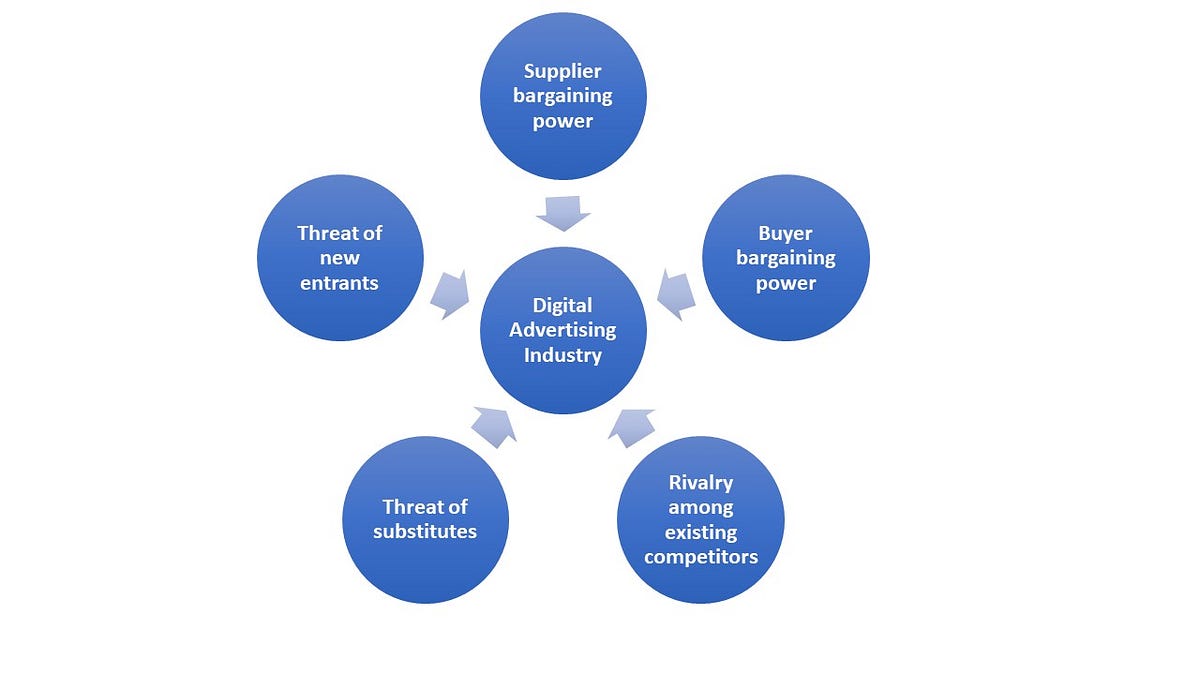
The Five Forces Analysis is an analytical tool proposed by Harvard Business School Professor Michael E. Porter in the 1980s. It’s primarily used to analyze industry structure and competitive environment. This analytical framework consists of five forces, each of which has an impact on the competitive status of the industry. Here is a brief introduction to the five forces:
- Supplier bargaining power: This refers to the ability of suppliers to exert pressure on companies in the industry, including raising prices or reducing the quality of products and services.
- Buyer bargaining power: This refers to the ability of buyers to exert pressure on companies in the industry, including demanding price reductions or improvements in the quality of products and services.
- Threat of new entrants: This refers to the possibility and ease of new companies entering the industry. If the barriers to entry are low, then the threat from new entrants is high.
- Threat of substitutes: This refers to other products or services that consumers may turn to. If substitutes are readily available and inexpensive, the threat from substitutes is high.
- Rivalry among existing competitors: This refers to the competition among other companies in the same industry for market share. In a highly competitive industry, company profits may be squeezed.
By analyzing these five forces, businesses can better understand the structure of their industry and develop more effective strategies. Next, we will analyze the digital advertising industry as an example.
1. Supplier Bargaining Power: The Power of Digital Advertising Platforms
In the digital advertising industry, suppliers are mainly the platforms that provide advertising services, including Google, Facebook, Instagram, and others. These platforms control the release and optimization of digital ads, giving them substantial bargaining power. For example, Google AdWords can determine ad rankings, and Facebook can control the audience reach of ads. Because they hold vast amounts of user data, they have a high level of power in negotiations.
Take Facebook as an example, with over 2 billion monthly active users, they can precisely target ads, which is an indispensable service for advertisers. They also have absolute control over the pricing of ads, which means the supplier’s bargaining power is very high for advertisers.

2. Buyer Bargaining Power: Advertisers’ Options
In the digital advertising industry, the buyers primarily consist of advertisers and brands. Taking Unilever as an example, one of the largest advertisers globally, they place a large amount of advertising on Google or Facebook and can choose different platforms to place their advertisements. However, due to the myriad advertising platforms on the market (such as Instagram, Twitter, Pinterest, etc.), each with their unique user base and promotional effectiveness, none can be completely replaced. Therefore, even though Unilever has many options, its position in bargaining is still not as strong as the suppliers’. Hence, the buyer bargaining power in the digital advertising industry is relatively low. Moreover, many advertisers lack specialized knowledge in the operation and optimization of digital advertising, so they have to rely on the services of the platforms. This further weakens advertisers’ bargaining power in price negotiations.

3. Threat of New Entrants: Challenge of Innovative Technologies
The entry barrier for the digital advertising industry is relatively low, and new advertising technologies and platforms keep emerging, bringing new competitive pressure to the industry. For example, with the development of technology, new social media platforms like TikTok have appeared and carried out advertising businesses. This new form of advertising poses a challenge to traditional search engine ads and social media ads. However, new entrants need a large amount of user data to make precise predictions and optimizations for advertising effectiveness, which undoubtedly increases the challenge for newcomers.
Take Snapchat as an example. Despite their large user base, to develop competitive advertising products and attract advertisers, a lot of human and financial resources need to be invested, and it takes time for adjustments and optimizations. Therefore, after Snapchat entered the digital advertising industry, it did not immediately pose a significant threat to Facebook or Google.

4. Threat of Substitutes: Transformation of Marketing Methods
Digital advertising is not the only marketing method. Its substitutes include traditional advertising, content marketing, social marketing, etc. In recent years, with consumers’ increasing resistance to advertisements and the rise of content marketing and social marketing, these alternative methods pose a certain threat to digital advertising. For instance, many brands choose to collaborate with influencers and promote products through social media. For example, in its 2020 marketing campaign, Nike used content marketing centered around athletes’ stories and promoted it on social media. This approach has lower costs compared to digital advertising and has a higher degree of trust and affinity.
Moreover, Seventh Generation, a cleaning product brand from Unilever, chose to abandon digital advertising and turn to more environmentally friendly marketing methods. These two examples all demonstrate that digital advertising is facing threats from other marketing methods.
However, this does not mean that the status of digital advertising has been replaced. As digital advertising has the advantages of broad range and high precision, it is still the first choice for many brands.

5. Rivalry Among Existing Competitors: Google and Facebook’s Contest
In the digital advertising industry, Google and Facebook are the two major competitors. From the data in 2022, Google and Facebook’s digital advertising revenues account for about 60% of the global market, with the remaining 40% shared by other platforms such as Twitter and LinkedIn. They have massive user data and can provide precise advertising services. In such competition, each platform is optimizing its advertising system and launching new advertising products to attract advertisers. However, due to Google and Facebook’s dominant position, other platforms are in a relatively disadvantaged position in this competition. For example, although Twitter and LinkedIn continue to launch new advertising products and optimization functions, due to the gap in the number of users and advertising effectiveness, their market share is far from comparable to Google and Facebook.

Through the five forces analysis, we can see the competitive environment of the digital advertising industry: strong bargaining power of suppliers, weak bargaining power of buyers, challenges faced by newcomers, threats from substitutes, and fierce competition among existing competitors. Despite this, digital advertising, with its wide coverage and precise delivery characteristics, remains an essential means of marketing. Brands and advertisers also need to keep learning and adapt to this rapidly changing industry.
The above is our five forces analysis of the digital advertising industry. We hope it can be helpful to you. If you have any questions or suggestions, feel free to comment below. If you like our article, please follow and share.
-
Applying the Big Five Personality Traits Theory in Career Planning
Have you ever wondered why some jobs make you feel satisfied and productive, while others just make you feel drained and frustrated? The answer may lie in your personality traits.
The Big Five Personality Traits Theory, also known as the Five Factor Model, suggests that there are five fundamental dimensions of personality: Openness, Conscientiousness, Extraversion, Agreeableness, and Neuroticism (or Emotional Stability). These traits can help us understand our behavioral tendencies and guide us in choosing a career that matches our personality.

Overview of the Big Five Personality Traits
- Openness: This trait characterizes those who are imaginative, creative, and open to new experiences. Individuals with high openness tend to be more interested in art, adventure, and intellectual pursuits.
- Conscientiousness: Individuals who score high in conscientiousness are typically organized, responsible, and dependable. They are diligent, pay attention to details, and are likely to plan ahead.
- Extraversion: This trait is associated with outgoing, sociable, and energetic individuals. Those who score high in extraversion tend to seek social stimulation and opportunities to engage with others.
- Agreeableness: People with high agreeableness are generally friendly, compassionate, and cooperative. They value social harmony and are often willing to compromise to maintain positive relationships.
- Neuroticism: This trait (also referred to as Emotional Stability) is associated with emotional instability and negative emotions. Those who score high in neuroticism may experience mood swings, anxiety, irritability, and sadness.
Knowing your personality traits can provide valuable insights when it comes to career planning. You can make decisions based on your strengths and interests, which can lead to higher job satisfaction and success.
Career Planning Based on Personality Traits
How can you apply the Big Five Personality Traits Theory to your career planning? You can start by taking a personality test to understand your dominant traits. Once you have a clear understanding of your personality, you can make decisions based on both your personality and professional interests. This might mean choosing a job that aligns with your personality traits, or further developing a certain trait to suit a job you are interested in.
This is a continuous process and might take some time and practice to find a job that suits you best. However, by integrating your personality traits with career planning, you can find a job that is more satisfying and successful for you.
Examples of Career Planning Based on Personality Traits
Let’s look at a specific example of how to apply the Big Five Personality Traits in career planning. Suppose your personality test results show that you score high in Openness and Agreeableness, and lower in Extraversion, Conscientiousness, and Neuroticism.
Scoring high in Openness and Agreeableness means that you are likely an innovative thinker who likes new experiences and ideas, and you are empathetic when dealing with people. However, lower Extraversion might mean that you don’t enjoy a lot of social interactions, and lower Conscientiousness might mean that you may struggle with completing tasks or maintaining an organized work style.
Considering these traits, jobs that might suit you could include artist, writer, psychologist, or any job that requires innovative thinking and understanding of others’ feelings. You might want to avoid jobs that require a lot of social interactions or high organization, such as sales or administrative roles.
Of course, this is just a simple example, and the actual career planning process might require consideration of many more factors such as your skills, experiences, and interests. However, hopefully, this example can demonstrate how to conduct career planning based on the Big Five Personality Traits Theory.
Developing Your Personality Traits for Career Success
It’s important to remember that the Big Five Personality Traits are not fixed and can be developed over time. You might find that you want to develop a certain trait to succeed in your chosen career. For instance, if you’re in a leadership position, you might want to develop your extraversion to effectively lead your team. Or, if you’re an artist, you might want to develop your openness to enhance your creativity.
So, how can you develop these personality traits? Here are some suggestions:
- Developing Openness: Explore different cultures, read widely, engage in creative activities, and seek out new experiences. These activities can stimulate your imagination and open your mind to different perspectives.
- Developing Conscientiousness: Set clear goals, create a schedule, keep your workspace organized, and practice being detail-oriented. These habits can help you become more organized and responsible.
- Developing Extraversion: Participate in social activities, practice public speaking, and build relationships. These can help you become more outgoing and confident in social situations.
- Developing Agreeableness: Practice active listening, show empathy, and be cooperative with others. These behaviors can help you develop your understanding and compassion towards others.
- Developing Neuroticism (Emotional Stability): Practice mindfulness, develop coping strategies for stress, and seek support when needed. These can help you manage your emotions more effectively.
Remember that developing personality traits is a lifelong journey. It requires self-awareness, patience, and consistency.

Conclusion
Career planning is a crucial step in our professional development. The Big Five Personality Traits Theory can provide a practical framework to guide our career choices and development. By understanding our personality traits, we can choose a career that aligns with our strengths and interests, and further develop our traits to achieve career success.
No matter what your career goals are, remember that your personality traits are unique strengths that can help you succeed. Embrace them, develop them, and let them guide you on your career journey.
In addition to the above, here’s a basic way to self-test for the Big Five Personality Traits. Please note that this is a simple self-assessment tool and does not replace detailed assessment by professional psychologists.
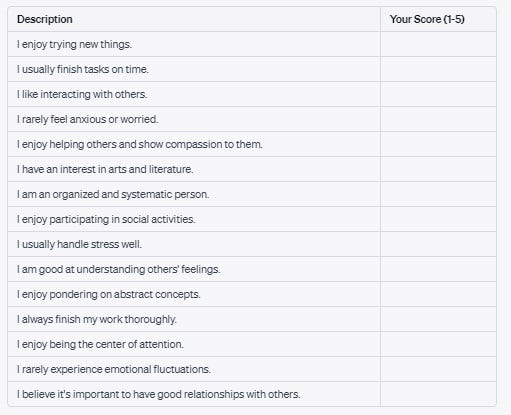
Please read the descriptions below and score yourself on a scale of 1 to 5 based on how much you think they align with you, where 1 stands for “Very Inaccurate” and 5 stands for “Very Accurate”.
For each trait, there are three related statements. Score each statement and then add these three scores to get a total score for each trait. This will help you understand whether your score for each trait is high or low compared to other traits. The maximum score is 15 and the minimum score is 3.
- Openness: I enjoy trying new things + I have an interest in arts and literature + I enjoy pondering on abstract concepts
- Conscientiousness: I usually finish tasks on time + I am an organized and systematic person + I always finish my work thoroughly
- Extraversion: I like interacting with others + I enjoy participating in social activities + I enjoy being the center of attention
- Emotional Stability: I rarely feel anxious or worried + I usually handle stress well + I rarely experience emotional fluctuations
- Agreeableness: I enjoy helping others and show compassion to them + I am good at understanding others’ feelings + I believe it’s important to have good relationships with others
Remember, this is a very basic test and can’t fully accurately describe your personality. More comprehensive tests will have more statements to evaluate each trait and may be conducted and interpreted by professionals.
-
The Future of Artificial Intelligence: Preparing for an AI-Dominated World
The rise of Artificial Intelligence (AI) is changing our world, with impacts reaching far beyond the field of technology and penetrating every aspect of our daily lives. As AI continues to evolve, we need to understand this new trend and prepare for a world dominated by AI.
The Emergence and Impact of AI
Over the past few years, AI has evolved from a figment of science fiction to a concrete reality. According to research by Statista, global AI market revenues are projected to surpass 190 billion USD by 2025. AI is making waves across various industries, from healthcare and finance to retail and entertainment. Techniques like machine learning, deep learning, and natural language processing are already impacting our daily lives.
Current State: The Application of AI Across Industries
Today, AI has become a component of many industries. In healthcare, AI is utilized for disease prediction and diagnosis, drug discovery, and patient monitoring. In finance, AI is used for risk assessment, fraud detection, and investment strategy. In retail, AI can offer personalized recommendations, improve inventory management, and predict consumer behavior.
For instance, Google’s DeepMind is leveraging AI for early warnings about diseases, while Alibaba uses AI to predict consumer buying behavior.
Skills Needed: What Skills Will be Necessary in the AI-Dominated Future?
In the world of AI, we’ll need to acquire new skills. Firstly, we need to learn how to interact with AI systems. This could include understanding how AI works and how to utilize AI tools to solve problems. Additionally, data analysis and data visualization will become critical skills, as AI often relies on large volumes of data.
Secondly, as AI is set to replace many traditional jobs, we need to be innovative and adaptable. This may involve learning new tools and technologies, and continuously updating our knowledge.
Lastly, human skills like critical thinking, creativity, communication, and leadership will remain irreplaceable, despite AI taking on more roles.
Opportunities and Challenges: How Will AI Change Professions and Ways of Working?
AI will not only change how we do things but also how we work. On the one hand, AI will create new job opportunities. According to a report by the World Economic Forum, AI and robots will create 127 million new job opportunities by 2025.
On the other hand, AI will also replace some existing jobs. According to research by McKinsey, between 800 million to 1.2 billion jobs globally could be automated by 2030.
These two trends pose a challenge: we need to prepare for the future job market. This may involve enhancing our skills and understanding new career opportunities.
Conclusion: How Individuals Can Prepare for this Rapidly Changing World
The rise of AI presents many opportunities and challenges. To succeed in this new world, in addition to learning new skills, we also need to be adaptable to change.
First, we need to learn how to interact with AI systems and understand how they operate. This may include learning new programming languages or understanding how to use new tools and platforms. It also includes learning how to handle and analyze big data, as it will be a key driver of AI.
Second, the ability to innovate and adapt to change is becoming increasingly important. This may involve learning new ways of working or seeking new job opportunities. And it is clear that AI is changing our work and lives, and this change will continue.
Lastly, we need to preserve our unique skills like critical thinking, creativity, communication, and leadership. While AI may replace some jobs, it cannot replace these skills.
The rise of AI is not a threat, but an opportunity. By learning new skills and adapting to change, we can seize this opportunity and succeed in an AI-dominated world.
So how can we learn these new skills and adapt to change? Many online learning platforms like Coursera, edX, and Udemy offer courses in AI and data analysis. You can also attend seminars, workshops, or reading clubs to enhance your knowledge.
Don’t fear change, embrace it. This is the key to success in the AI-dominated future.
AI is changing our world. It’s time we prepared to embrace this new world.
If you liked this article, don’t forget to hit “applaud,” and follow for more exciting content!
-
New Business Models in 2023: The Impact of Social Media on Consumer Behavior
Social media has become an integral part of our lives, whether it’s keeping in touch with friends and family or getting the latest news and entertainment. However, social media has not only transformed our social habits but also profoundly affected consumer behavior, creating new business models.

The Rise of Social Media and Its Impact on Consumer Behavior
According to Statista’s data, the number of global social media users will exceed 3.9 billion by 2023. From Facebook to Instagram, from Twitter to TikTok, social media has become our main conduit for information, self-expression, and consumption.
This trend has profound implications for business models. As consumers increasingly rely on social media for shopping information, brands need to establish their presence on these platforms. This might involve using social media advertising, creating brand communities, or collaborating with influencers.
Changes in Consumer Behavior: From Consumers to Creators
However, the impact of social media on consumer behavior extends far beyond these points. It has transformed the relationship between consumers and brands, turning consumers from passive receivers into active creators.
TikTok, for example, serves as an excellent illustration. On this platform, consumers can not only view brand advertisements but also create their content and even become brand ambassadors. For instance, the American teenager D’Amelio leveraged TikTok to become a renowned influencer, collaborating with numerous major brands.
New Business Models: Social Commerce

Driven by social media, new business models are emerging. One such example is social commerce.
Social commerce refers to consumers purchasing goods or services directly on social media platforms. One advantage of this model is that consumers can discover products, obtain reviews, and complete purchases on the same platform. This provides a convenient shopping experience for consumers and an opportunity for brands to interact directly with consumers.
For example, Instagram has launched the Instagram Shop feature, allowing users to buy goods directly within the app. According to Facebook’s data, over 1.3 million businesses have set up their shops on Instagram.
Skill Requirements: How to Seize the Opportunities of Social Media?
To succeed in this new business model driven by social media, brands need to acquire some new skills.
First, brands need to learn how to interact with consumers on social media. This might involve creating engaging content, responding to consumer comments, or collaborating with influencers.
Secondly, brands need to learn how to leverage social media data for decision-making. This could involve analyzing consumer behavior data, predicting consumer demands, or measuring the effectiveness of social media campaigns.
Finally, brands need to learn how to establish their presence on social media. This might involve using social media advertising, building brand communities, or developing a social media strategy for the brand.
Conclusion: The Future of Social Media
Social media is transforming our consumer behavior and shaping new business models. To succeed in this new world, brands need to learn new skills and continually adapt to changes.
With the ongoing development of social media, we can anticipate even more changes. Whether it’s virtual reality, augmented reality, blockchain, or cryptocurrencies, all these could become new trends in social media and further change our consumer behavior.
However, regardless of what the future of social media looks like, one thing is certain: social media will continue to influence our lives and business models. Therefore, for brands, now is the time to start learning how to seize the opportunities of social media and prepare for the future.
Of course, learning these new skills is not easy. However, there are many resources to help brands succeed in this regard. For instance, many social media platforms provide advertising and analytics tools. In addition, there are numerous online courses and workshops to help brands learn how to achieve success on social media.
Lastly, we need to remember that social media is just a tool. The real key is how to use this tool to create value. This requires brands to understand consumer needs, create engaging content, and build genuine relationships. Only in this way can brands succeed in the world of social media.
Social media is changing our world. It’s time for us to be prepared to embrace this new world.
If you liked this article, don’t forget to hit “applaud,” and follow for more exciting content!
-
AI and Future Management: A New Force Leading Change
Artificial Intelligence (AI) has not only achieved innovation in medical, manufacturing, and financial fields, but it has also opened up new perspectives and methods in the field of management. This article will delve into how AI influences future management practices, supplemented with related theories and examples for analysis.

Data-Driven Decision Making
In modern management practice, the importance of decision-making is self-evident. However, due to the limitations of traditional management methods, such decisions are often based on limited information and subjective judgment. The advent of AI provides us with the possibility to make more accurate and effective decisions driven by data.
According to Mintzberg’s management theory, a successful manager needs to play a good role as an information processor. With the rapid growth of data, the amount of information that managers need to handle is also growing astonishingly. In this case, AI can help managers effectively process large amounts of data and extract valuable insights from it.
For example, Walmart uses AI data analysis systems for sales forecasting and inventory management. This allows them to more accurately grasp market changes and formulate strategies that are more adaptive to the market, thereby improving efficiency and profits. Additionally, AI predictive analytics tools can help managers anticipate market changes, leading to more effective strategies.
Automated Workflow
Another important impact of AI is the ability to automate many cumbersome management tasks, such as planning, coordination, and control. This automation not only improves efficiency but also reduces the possibility of human error.
For example, IBM’s Watson can automatically process large amounts of data and make decisions. This frees managers from the tedious work of data processing and gives them more time and energy to deal with more challenging issues. This effect is very helpful in improving overall management efficiency.
Management Innovation and Change
The core of management innovation and change lies in the innovative power of AI. Schumpeter’s innovation theory believes that disruptive innovation will cause significant changes in industry structure, and AI is an important example of such disruptive innovation. With the advancement of AI, companies need to rethink their business models and management strategies to adapt to this new era.
For instance, Uber and Lyft have thoroughly changed the traditional taxi industry through AI-driven applications. Their success is a paradigm of Schumpeter’s theory of disruptive innovation, demonstrating how to lead industry change through innovative business models and management strategies.
Enhancing Customer Satisfaction and Experience
AI can also significantly enhance customer satisfaction and experience. Through AI technology, companies can understand customer needs more accurately, provide personalized services, and offer real-time customer support. This is closely related to Kano’s customer satisfaction model, which argues that satisfaction comes from the part of a product or service that exceeds customer expectations.
For example, Amazon’s recommendation system is an example of using AI to enhance customer satisfaction and experience. The system recommends products that customers may be interested in by analyzing their shopping behavior, thereby enhancing the customer’s shopping experience and satisfaction.
Enhancing Enterprise Competitiveness
The use of AI can significantly enhance enterprise competitiveness. According to Porter’s Five Forces Analysis theory, enterprise competitiveness comes from five core factors: bargaining power of buyers, bargaining power of suppliers, threat of new entrants, threat of substitutes, and rivalry among existing competitors. AI can help companies gain advantages in these five forces.
For example, Walmart uses AI in supply chain management, effectively reducing the bargaining power of suppliers and thus enhancing its own competitiveness. Their success shows how to use AI technology to enhance enterprise competitiveness.
The above analysis is summarized in the following table:
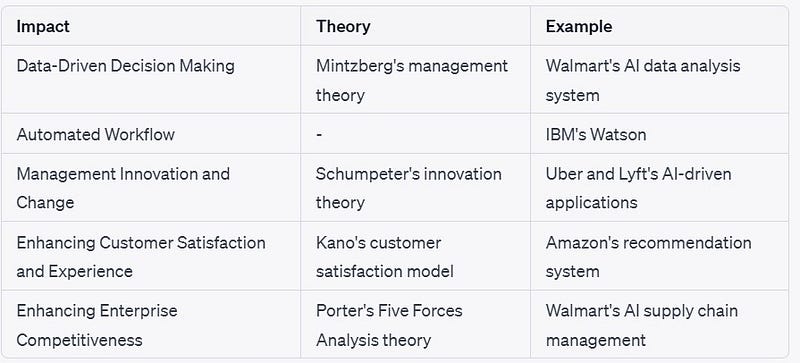
In conclusion, the application of AI will indeed have profound effects on future management practices. AI has fundamentally changed various management activities, from decision-making and workflow automation to improving employee and customer satisfaction. At the same time, AI provides unparalleled opportunities for management change and innovation, as well as enhancing enterprise competitiveness. However, the development of AI also brings challenges, including data security and privacy issues, as well as potential impacts on the labor market and social structure. Therefore, enterprises and managers need to continue learning and adapting to stay competitive in this rapidly changing world.
If you liked this article, don’t forget to hit “applaud,” and follow for more exciting content!
-
A New Perspective on Maslow’s Hierarchy of Needs: Integrating AI and Post-pandemic Impacts

A New Perspective on Maslow’s Hierarchy of Needs: Integrating AI and Post-pandemic Impacts
Human needs are never isolated; they pile up, shaping our behaviors, dreams, and even our future. The best way to understand this is through Maslow’s hierarchy of needs. This theory was proposed in 1943 by psychologist Abraham Maslow, which describes human needs in five levels: physiological, safety, social, esteem, and self-actualization needs. Maslow argued that lower-level needs must be satisfied before people can pursue higher-level needs.
With the evolution of technology, especially the advancement of AI and other new technologies, and the arrival of the global post-pandemic era, new interpretations and explanations have been given to Maslow’s hierarchy of needs. Let’s take a look at these new interpretations together.

Physiological needs
Physiological needs are the most basic part of the hierarchy, including food, sleep, breathing, and other basic physiological activities. In this regard, AI and other new technologies have significantly changed our way of life. For example, smart home systems can control indoor temperature, lighting, and other basic facilities. Smart refrigerators can automatically replenish food, and AI health trackers can monitor our sleep patterns and health status.
Safety Needs
Safety needs include personal health and welfare, economic security, and family safety. In this level of needs, AI and new technologies also play an important role. For instance, AI security systems can provide 24-hour protection in our homes and workplaces. In the post-pandemic era, AI also played a crucial role in tracking disease spread and vaccine distribution.
Social Needs
Social needs cover friendship, family, intimate relationships, and a sense of community. AI and new technologies have profound effects on this, especially in remote work and life during and after the pandemic. We maintain connections through various online platforms for work meetings, and even social activities. AI-driven social media platforms also allow us to connect with people around the world.
Esteem Needs
Esteem needs involve self-esteem, respect for others, and being respected by others. In this level of needs, AI and new technologies may pose some challenges because as AI becomes more prevalent, people might feel confused about their self-worth and the role of humans. However, AI also provides us with new opportunities, such as enhancing skills through online learning platforms, or creating personal brands to increase our influence in the digital world.
Self-actualization Needs
Self-actualization needs are the highest level of Maslow’s hierarchy of needs, including the pursuit of personal growth and self-fulfillment. In this regard, AI and new technologies have created countless possibilities. For example, we can use AI to learn new languages, do creative writing, or conduct various researches. The pandemic also made us rethink our lifestyle and work style, providing us with new opportunities to achieve our self-actualization needs.
Maslow’s hierarchy of needs is a powerful framework that not only helps us understand our needs and motivations but also helps us understand how new technologies, especially AI, shape our lives. However, we also need to realize that changes brought about by AI and new technologies have both positive and negative sides and may bring new challenges. Only by understanding this can we fully utilize these tools to meet our needs and ultimately achieve our self-actualization.
If you liked this article, don’t forget to hit “applaud,” and follow for more exciting content!
-
AI, Post-Pandemic Era, and Cognitive Dissonance: Adapting to a New Reality?
As we enter the post-pandemic era, new technologies like AI are rapidly transforming our ways of living and working. In the midst of these changes, we may find ourselves in situations where our beliefs or behaviors are inconsistent with this new reality, resulting in inner discomfort. This phenomenon, termed ‘cognitive dissonance’ by psychologist Leon Festinger in 1957, is all too common.

Cognitive Dissonance Theory: The Price of Psychological Inconsistency
The core concept of cognitive dissonance theory is that when our beliefs (or cognitions) are inconsistent with our behaviors, we experience internal tension and discomfort. To alleviate this psychological discomfort, we strive to change our beliefs or behaviors to align them with each other.
This theory has significant implications for understanding how we adapt to new life and work environments. After all, new technologies and societal changes may conflict with our existing beliefs and behaviors, leading to cognitive dissonance.
AI and Cognitive Dissonance: How to Adapt to New Technologies?
In the world of AI, we might face cognitive dissonance. For instance, consider the issue of privacy. We might believe that sharing information in the digital world is necessary, yet at the same time, we fear that AI could invade our privacy. This contradiction can lead to cognitive dissonance, forcing us to seek solutions, such as being more cautious when sharing personal information or changing our views on privacy.
Similarly, the application of AI in the workplace can lead to cognitive dissonance. As AI gradually replaces certain jobs, we may need to adjust our understanding of work value and self-worth.
Post-Pandemic Cognitive Dissonance: How to Adapt to the New Normal?
In the post-pandemic era, cognitive dissonance might surface in new ways. The pandemic has altered our ways of life and work, and as we attempt to return to pre-pandemic norms, we may find our expectations inconsistent with reality. This cognitive dissonance may require us to find new ways to adapt to new lifestyles, such as accepting remote work or online learning.
Conclusion: A Psychological Weapon for Adapting to a New Reality
Cognitive dissonance theory offers a framework for understanding and dealing with psychological conflicts in our lives. In the era of AI and the post-pandemic world, this theory may be even more important. We need to recognize that when our beliefs and actions are inconsistent, we experience discomfort and need to seek change. This understanding can help us better adapt to new living and working environments and better face the changes and challenges of the future.
If you liked this article, don’t forget to hit “applaud,” and follow for more exciting content!
首頁
1–2 minutes
 Da Vinci's notebook