The Five Forces Analysis is an analytical tool proposed by Harvard Business School Professor Michael E. Porter in the 1980s. It’s primarily used to analyze industry structure and competitive environment. This analytical framework consists of five forces, each of which has an impact on the competitive status of the industry. Here is a brief introduction to the five forces:
- Supplier bargaining power: This refers to the ability of suppliers to exert pressure on companies in the industry, including raising prices or reducing the quality of products and services.
- Buyer bargaining power: This refers to the ability of buyers to exert pressure on companies in the industry, including demanding price reductions or improvements in the quality of products and services.
- Threat of new entrants: This refers to the possibility and ease of new companies entering the industry. If the barriers to entry are low, then the threat from new entrants is high.
- Threat of substitutes: This refers to other products or services that consumers may turn to. If substitutes are readily available and inexpensive, the threat from substitutes is high.
- Rivalry among existing competitors: This refers to the competition among other companies in the same industry for market share. In a highly competitive industry, company profits may be squeezed.
By analyzing these five forces, businesses can better understand the structure of their industry and develop more effective strategies. Next, we will analyze the digital advertising industry as an example.
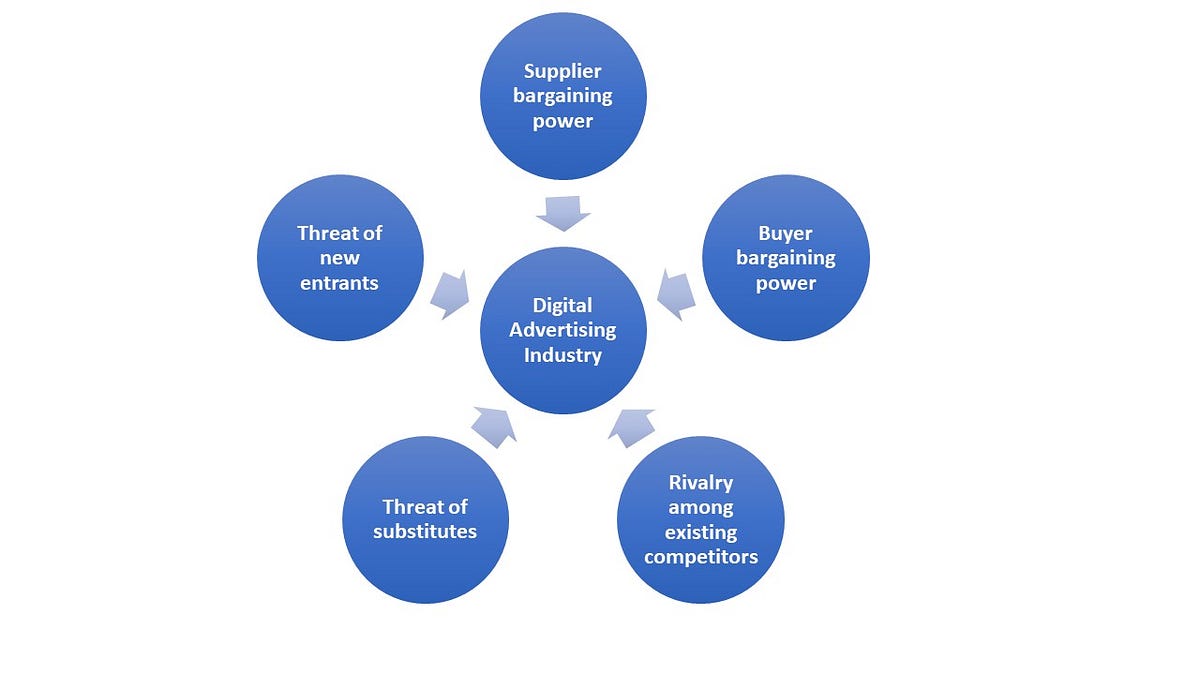
1. Supplier Bargaining Power: The Power of Digital Advertising Platforms
In the digital advertising industry, suppliers are mainly the platforms that provide advertising services, including Google, Facebook, Instagram, and others. These platforms control the release and optimization of digital ads, giving them substantial bargaining power. For example, Google AdWords can determine ad rankings, and Facebook can control the audience reach of ads. Because they hold vast amounts of user data, they have a high level of power in negotiations.
Take Facebook as an example, with over 2 billion monthly active users, they can precisely target ads, which is an indispensable service for advertisers. They also have absolute control over the pricing of ads, which means the supplier’s bargaining power is very high for advertisers.

2. Buyer Bargaining Power: Advertisers’ Options
In the digital advertising industry, the buyers primarily consist of advertisers and brands. Taking Unilever as an example, one of the largest advertisers globally, they place a large amount of advertising on Google or Facebook and can choose different platforms to place their advertisements. However, due to the myriad advertising platforms on the market (such as Instagram, Twitter, Pinterest, etc.), each with their unique user base and promotional effectiveness, none can be completely replaced. Therefore, even though Unilever has many options, its position in bargaining is still not as strong as the suppliers’. Hence, the buyer bargaining power in the digital advertising industry is relatively low. Moreover, many advertisers lack specialized knowledge in the operation and optimization of digital advertising, so they have to rely on the services of the platforms. This further weakens advertisers’ bargaining power in price negotiations.

3. Threat of New Entrants: Challenge of Innovative Technologies
The entry barrier for the digital advertising industry is relatively low, and new advertising technologies and platforms keep emerging, bringing new competitive pressure to the industry. For example, with the development of technology, new social media platforms like TikTok have appeared and carried out advertising businesses. This new form of advertising poses a challenge to traditional search engine ads and social media ads. However, new entrants need a large amount of user data to make precise predictions and optimizations for advertising effectiveness, which undoubtedly increases the challenge for newcomers.
Take Snapchat as an example. Despite their large user base, to develop competitive advertising products and attract advertisers, a lot of human and financial resources need to be invested, and it takes time for adjustments and optimizations. Therefore, after Snapchat entered the digital advertising industry, it did not immediately pose a significant threat to Facebook or Google.

4. Threat of Substitutes: Transformation of Marketing Methods
Digital advertising is not the only marketing method. Its substitutes include traditional advertising, content marketing, social marketing, etc. In recent years, with consumers’ increasing resistance to advertisements and the rise of content marketing and social marketing, these alternative methods pose a certain threat to digital advertising. For instance, many brands choose to collaborate with influencers and promote products through social media. For example, in its 2020 marketing campaign, Nike used content marketing centered around athletes’ stories and promoted it on social media. This approach has lower costs compared to digital advertising and has a higher degree of trust and affinity.
Moreover, Seventh Generation, a cleaning product brand from Unilever, chose to abandon digital advertising and turn to more environmentally friendly marketing methods. These two examples all demonstrate that digital advertising is facing threats from other marketing methods.
However, this does not mean that the status of digital advertising has been replaced. As digital advertising has the advantages of broad range and high precision, it is still the first choice for many brands.

5. Rivalry Among Existing Competitors: Google and Facebook’s Contest
In the digital advertising industry, Google and Facebook are the two major competitors. From the data in 2022, Google and Facebook’s digital advertising revenues account for about 60% of the global market, with the remaining 40% shared by other platforms such as Twitter and LinkedIn. They have massive user data and can provide precise advertising services. In such competition, each platform is optimizing its advertising system and launching new advertising products to attract advertisers. However, due to Google and Facebook’s dominant position, other platforms are in a relatively disadvantaged position in this competition. For example, although Twitter and LinkedIn continue to launch new advertising products and optimization functions, due to the gap in the number of users and advertising effectiveness, their market share is far from comparable to Google and Facebook.

Through the five forces analysis, we can see the competitive environment of the digital advertising industry: strong bargaining power of suppliers, weak bargaining power of buyers, challenges faced by newcomers, threats from substitutes, and fierce competition among existing competitors. Despite this, digital advertising, with its wide coverage and precise delivery characteristics, remains an essential means of marketing. Brands and advertisers also need to keep learning and adapt to this rapidly changing industry.
The above is our five forces analysis of the digital advertising industry. We hope it can be helpful to you. If you have any questions or suggestions, feel free to comment below. If you like our article, please follow and share.
 Da Vinci's notebook
Leave a comment