Artificial Intelligence (AI) has not only achieved innovation in medical, manufacturing, and financial fields, but it has also opened up new perspectives and methods in the field of management. This article will delve into how AI influences future management practices, supplemented with related theories and examples for analysis.

Data-Driven Decision Making
In modern management practice, the importance of decision-making is self-evident. However, due to the limitations of traditional management methods, such decisions are often based on limited information and subjective judgment. The advent of AI provides us with the possibility to make more accurate and effective decisions driven by data.
According to Mintzberg’s management theory, a successful manager needs to play a good role as an information processor. With the rapid growth of data, the amount of information that managers need to handle is also growing astonishingly. In this case, AI can help managers effectively process large amounts of data and extract valuable insights from it.
For example, Walmart uses AI data analysis systems for sales forecasting and inventory management. This allows them to more accurately grasp market changes and formulate strategies that are more adaptive to the market, thereby improving efficiency and profits. Additionally, AI predictive analytics tools can help managers anticipate market changes, leading to more effective strategies.
Automated Workflow
Another important impact of AI is the ability to automate many cumbersome management tasks, such as planning, coordination, and control. This automation not only improves efficiency but also reduces the possibility of human error.
For example, IBM’s Watson can automatically process large amounts of data and make decisions. This frees managers from the tedious work of data processing and gives them more time and energy to deal with more challenging issues. This effect is very helpful in improving overall management efficiency.
Management Innovation and Change
The core of management innovation and change lies in the innovative power of AI. Schumpeter’s innovation theory believes that disruptive innovation will cause significant changes in industry structure, and AI is an important example of such disruptive innovation. With the advancement of AI, companies need to rethink their business models and management strategies to adapt to this new era.
For instance, Uber and Lyft have thoroughly changed the traditional taxi industry through AI-driven applications. Their success is a paradigm of Schumpeter’s theory of disruptive innovation, demonstrating how to lead industry change through innovative business models and management strategies.
Enhancing Customer Satisfaction and Experience
AI can also significantly enhance customer satisfaction and experience. Through AI technology, companies can understand customer needs more accurately, provide personalized services, and offer real-time customer support. This is closely related to Kano’s customer satisfaction model, which argues that satisfaction comes from the part of a product or service that exceeds customer expectations.
For example, Amazon’s recommendation system is an example of using AI to enhance customer satisfaction and experience. The system recommends products that customers may be interested in by analyzing their shopping behavior, thereby enhancing the customer’s shopping experience and satisfaction.
Enhancing Enterprise Competitiveness
The use of AI can significantly enhance enterprise competitiveness. According to Porter’s Five Forces Analysis theory, enterprise competitiveness comes from five core factors: bargaining power of buyers, bargaining power of suppliers, threat of new entrants, threat of substitutes, and rivalry among existing competitors. AI can help companies gain advantages in these five forces.
For example, Walmart uses AI in supply chain management, effectively reducing the bargaining power of suppliers and thus enhancing its own competitiveness. Their success shows how to use AI technology to enhance enterprise competitiveness.
The above analysis is summarized in the following table:
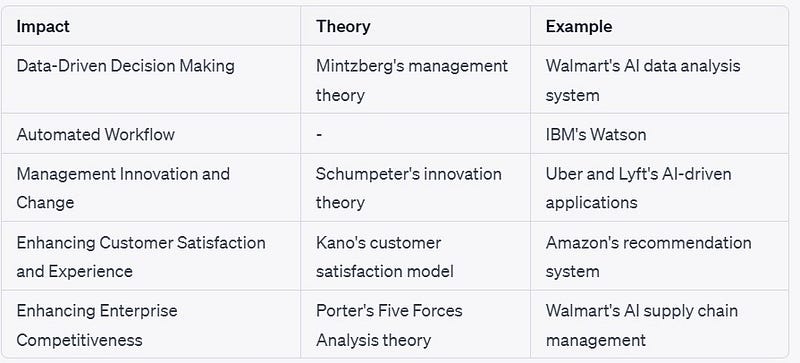
In conclusion, the application of AI will indeed have profound effects on future management practices. AI has fundamentally changed various management activities, from decision-making and workflow automation to improving employee and customer satisfaction. At the same time, AI provides unparalleled opportunities for management change and innovation, as well as enhancing enterprise competitiveness. However, the development of AI also brings challenges, including data security and privacy issues, as well as potential impacts on the labor market and social structure. Therefore, enterprises and managers need to continue learning and adapting to stay competitive in this rapidly changing world.
If you liked this article, don’t forget to hit “applaud,” and follow for more exciting content!
 Da Vinci's notebook
Leave a comment